


RESULTS
Between 2020 and 2024, World Bank operations to strengthen health systems have improved access to better quality health services for the populations of Kiribati, Samoa, and Tuvalu, some 340,000 people.
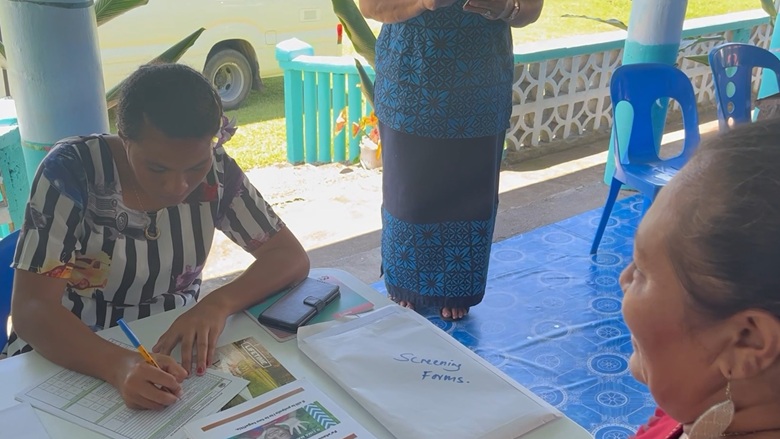
In Samoa, World Bank support has enabled the rapid expansion of PEN Fa’a Samoa, a community-focused program whose name references the “Samoa Way” and that is bolstering systems to detect, manage, and prevent NCDs. Communications and advocacy initiatives that inform the public of NCD risk factors—including media campaigns and village-led health activities like regular Zumba classes—are being rolled out across the entire population. Ninety seven percent of those screened in the first two years of the Program reported improved knowledge and awareness of NCD risk factors and a third of respondents reported positive changes in health behavior. Screening programs have been rolled out in 19 of 34 districts prioritized by the Ministry of Health, and 12 of these districts reached the target of having at least 70 percent of their adult population and 60 percent of the male population screened. The size of the health workforce has increased. All eight of Samoa’s rural district hospitals have expanded staff and half now have fully expanded teams of frontline workers, including doctors, nurses, environmental health officers, and data officers. Samoa is the only country in the Pacific region to use the World Bank’s Program for Results financing instrument to strengthen on-budget and on-government-system implementation of its NCD program.

In Kiribati, approximately 30 percent of the workforce, comprising 334 health professionals, have received training on a range of topics, including mental health, effective communication, and working with infectious substances. Of these professionals, nearly 75 percent are women. The long-term management of digital patient data at the national referral hospital in Kiribati’s capital, Tarawa, has been enhanced by the purchase of a Picture Archiving and Communication System with an integrated computed tomography (CT) scanner. This has enabled radiologists and doctors to receive patients’ CT scan images instantly, streamlining patient assessments and diagnoses, speeding up treatment times and reducing waiting times. Each of the four main hospitals—which together provide services to around 106,000 people, or 80 percent of the population—invested in new ambulances to expand patient transfer and emergency response. Assessments of 75 outer-island health facilities, which represent 63 percent of the country’s health facilities, have been completed, giving the authorities a clear view of infrastructure, medical equipment, and training needs.
In Tuvalu, the Princess Margaret Hospital (PMH), the only hospital in the country has improved its dentistry services and its existing operating theatre with a state-of-the-art operating table. A new wing is expected to be completed in 2027 to significantly improve essential health services that can be offered in-country for 100 percent of population of Tuvalu, roughly 11,000 people. In 2025, Tuvalu purchased Starlink for 11 Outer Island health clinics and PMH, which will improve communications between healthcare service providers, enable the transition from paper to digital records and lay the foundation for digital health and trainings. In the same logic of serving patients closer to home, Tuvalu has completed an assessment of Outer Island services to underpin the formulation of a standardized primary healthcare service package and the design of clinics that are fit for purpose for small, remote populations. These are to be delivered by 2027. To ensure services that are accessible for all, Tuvalu has invested in a vehicle adapted to accommodate people with disabilities as part of its outreach program. It will significantly improve screenings and check-ups to improve disease management and prevent complications that may require hospital treatment. Tuvalu has also strengthened its healthcare workforce through a training program to increase the number of first responders able to recognize and respond to victims of gender-based violence.

link
More Stories
UniHealth Hospitals Limited Announces the Commissioning of its Advanced Tertiary Care, Multi-Specialty Hospital in Navi Mumbai
Predictors of opportunistic infections among people living with HIV: a prospective cohort study from a tertiary care setting in India
The impact of DRG payment reform on inpatient costs for different surgery types: an empirical analysis based on Chinese tertiary hospitals