



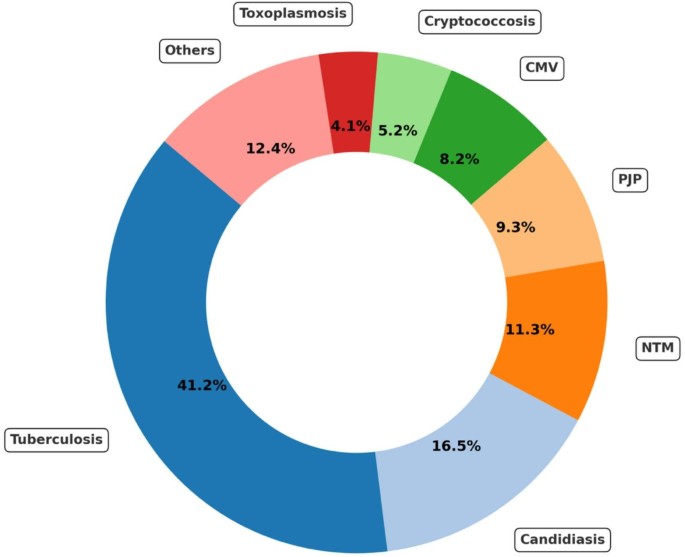
In this prospective cohort study conducted at a tertiary care center in Western India, we found a significant burden of OIs among people living with HIV. Approximately 43% of patients in the cohort developed at least one OI during follow-up. Tuberculosis, candidiasis, and non-tuberculous mycobacterial infections were the most frequently reported OIs. Despite the widespread availability and early initiation of ART, these findings highlight the increased susceptibility of PLHIV for developing OIs. Previous studies have also reported a high incidence of OIs among PLHIV, ranging from 27% to 52%9,14,15. However, there is a dearth of longitudinal data from the Indian setting, which this study aims to address. Despite a relatively shorter follow-up, our study observed a high incidence of OIs (43.5%) compared to longer-duration studies (ranging from 60 months to 120 months)6,9,16. This pattern suggests that a significant proportion of OIs in our cohort occur early in the course of HIV care; which also reflecting the delayed diagnosis, advanced disease at presentation, or inadequate immune recovery. The median time to OI development was 16 months in this study, which is unusual after ART initiation. Although OIs are expected to decrease within the first 6 months of ART, the longer median time to OIs in this study likely reflects delayed immune recovery and variable ART adherence. Similar late-onset OIs have been described in other cohorts, including a Latin American study reporting a median onset of 2.1 years17.
In this cohort, mycobacterium tuberculosis (pulmonary and extrapulmonary tuberculosis) was found to be the most common OI, which is consistent with findings from other studies in resource-limited settings9,10. Moreover, we did not find a high incidence of chronic diarrhea or skin infections as reported in some African cohorts6,10, possibly reflecting regional microbiological differences and improved sanitation. The results of this study highlight the importance of the immunological and nutritional status of PLHIV for the development of OIs. A baseline CD4 count < 250 cells/µL was independently associated with OI development, consistent with previous literature10,18. Many patients in this cohort had low CD4 counts despite being on ART. This was mainly due to late presentation with advanced HIV and, in some cases, possible suboptimal adherence leading to incomplete immune recovery. Immunosuppression is a well-established key factor for OI predictors in the literature19,20; however, this study identifies baseline nutritional status as a major determinant of future OI development. We identified hypoalbuminemia (< 2.5 g/dL) and undernutrition (BMI < 18.5 kg/m2) as significant predictors of OIs. A retrospective cohort study by Woldegeorgis et al., in 537 participants, described an increased hazard of developing OIs in mildly malnourished patients (defined as BMI from 17 to 18.5) [HR 1.62; 95% CI 1.1–2.5; P = 0.035] compared to those without malnutrition6.
Previous studies have identified serum albumin levels as a determinant of poor outcomes and mortality in HIV patients21,22. A study from Tanzania reported hypoalbuminemia (< 3.8 g/dL) as an independent factor for increased incidence of pulmonary tuberculosis (P < 0.001), severe anemia (P < 0.001), and mortality21. Low serum albumin in PLHIV reflects a combination of malnutrition, chronic inflammation, and advanced disease burden. Hypoalbuminemia leads to reduced T-cell function, impaired mucosal barriers, and reduced antioxidant defence mechanisms23,24,25, resulting in increasing host susceptibility to OIs. Moreover, it also serves as a surrogate marker for protein loss due to enteropathy or nephropathy in advanced HIV23,26,27. Overall, albumin not only indicates nutritional status but also represents the underlying immunosuppressive milieu that predisposes patients to OIs.
Although ART non-adherence is a known risk factor for OIs, as described by previous reports6, this study did not find a significant difference in OI-free survival between ART-adherent and non-adherent groups. This could be due to self-reported adherence, which may have introduced bias. In addition, another reason could be the relatively short follow-up period, which may not have captured the delayed effects of poor adherence. The absence of a significant difference in OI-free survival between adherent and non-adherent groups likely reflects variable adherence patterns and immune recovery. Several patients with temporary ART interruptions later resumed therapy, whereas some adherent individuals continued to have advanced immunosuppression or treatment failure, diminishing the between-group differences. Thus, the lack of statistical difference likely reflects overlap between irregular treatment and partial immune recovery rather than true equivalence of adherence outcomes. Furthermore, the baseline immune status and nutritional status may have had a more immediate impact on OI risk than adherence alone in our cohort. By incorporating simple, cost-effective parameters such as BMI and serum albumin, which are often underutilized, these may serve as practical tools to identify patients at higher risk of developing OIs. The clinical implications of this study are relevant in resource-limited settings, where timely and accurate prognostication can improve care delivery and optimize resource allocation.
A key strength of this study was its prospective design, which enables the temporal assessment of OI development and minimizing the recall bias. However, our study also has some important limitations. Diagnoses of OIs were predominantly based on clinical and laboratory findings available in a routine care setting; advanced diagnostics for certain infections (PCR and other molecular analyses) were not available. Although this was a prospective cohort, repeat assessment of ART adherence, viral load, and serial CD4 count were not performed uniformly due to logistical and resource limitations. Hence, baseline values were used as representative of initial immune and nutritional status. We acknowledge that serial monitoring could provide more precise insights into temporal associations between immune recovery and OI risk, and future multicentric cohorts with CD4 count follow-up are needed to validate these findings. This limitation may partly explain why some patients had persistently low CD4 counts despite being on ART. ART adherence monitoring was based on available records, and incomplete documentation may have underestimated its association with late OIs. Additionally, certain confounding factors, such as socioeconomic status and co-existing non-communicable diseases, were not evaluated. In addition, data of viral load, and treatment failure assessment were not available; therefore, CD4 count was used as a surrogate marker of immune status at the time of OIs. Finally, the single-center design of this study may limit its generalizability across different geographic settings.
link
More Stories
UniHealth Hospitals Limited Announces the Commissioning of its Advanced Tertiary Care, Multi-Specialty Hospital in Navi Mumbai
The impact of DRG payment reform on inpatient costs for different surgery types: an empirical analysis based on Chinese tertiary hospitals
UniHealth Hospitals Limited Announces the Commissioning of its Advanced Tertiary Care, Multi-Specialty Hospital in Navi Mumbai